
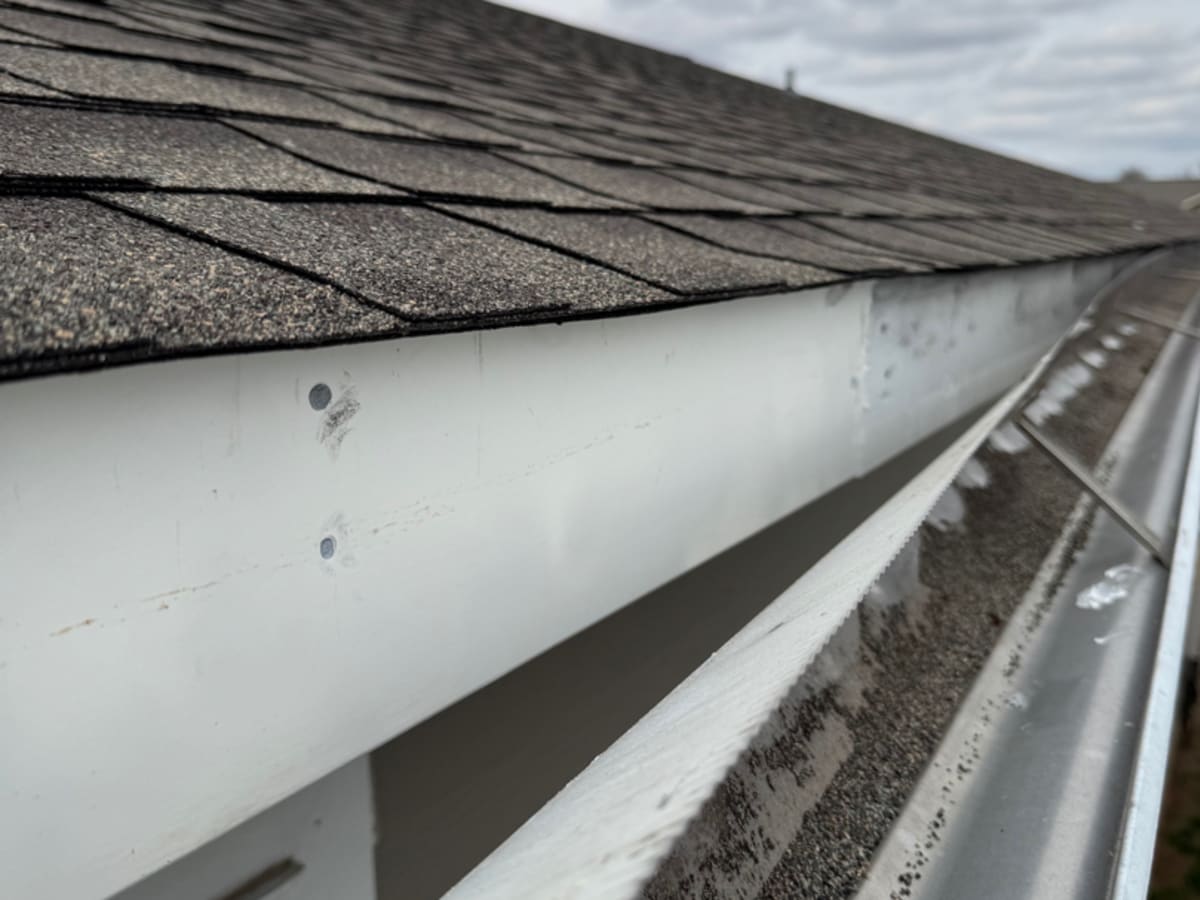
The hail lasted maybe four minutes. It sounded like someone emptying a truckload of gravel onto the roof, and then it was over, and the sun came out like nothing happened.
Now you're standing in the yard looking up at the gutters and wondering whether those little dimples were always there, whether they matter, and whether this is one of those "call the insurance company" situations.
Here's how to tell. (For damage from wind and falling limbs, see our post on wind damage to gutters. This one is about hail.)
What Hail Damage on Gutters Looks Like
Gutters are usually the easiest place on a house to see hail damage. Shingles hide it. Aluminum doesn't.
On aluminum gutters: round dents, usually on the top edge of the front lip and the face of the gutter, more on the side of the house the storm came from. Small hail leaves dimples. Bigger hail leaves dents you can see from the street.
On downspouts: dents along the face that took the hit, sometimes enough to pinch the downspout narrower. Downspouts are thin and hollow, so they show hail before almost anything else.
On vinyl gutters: vinyl doesn't dent. It cracks or punches through. Look for splits and holes, especially on older vinyl that's gone brittle in the sun.
Look around, too. Hail that dented the gutters probably hit the AC unit fins, the mailbox, the grill lid and the car on the driveway. Dents on all of those, on the same side, tell a consistent story.
Checking From the Ground
You don't need a ladder to do a first pass, and right after a storm you shouldn't be on one anyway. A few tricks:
- Use low sun. Dents in a painted gutter nearly vanish at noon. Early morning or late afternoon light skims across the face and throws every dimple into shadow.
- Look along the gutter, not at it. Stand at a corner of the house and sight down the length of the run. Dents and sags show up as wobbles in what should be a straight line.
- Bring binoculars. Seriously. They're the cheapest gutter inspection tool there is.
- Check the downspouts by hand. They're at arm's height. Run your palm down the face, and you'll feel dents you can't see.
- Watch the next rain. Water spilling over the front where it never did before, or a new drip at a corner, tells you a dent changed something.
Cosmetic Dents vs. Real Damage
Here's an honest admission that might save you a phone call: a lot of hail dents on gutters are cosmetic. The gutter still holds water and drains just fine. It just looks like it was in a fight.
Dents become a real problem when they change how the gutter works:
- Dents in the bottom of the gutter that create low spots where water sits
- A crushed or bent front lip that lets water spill over
- Dents near a corner, end cap or downspout outlet, where they can crack sealant and start a leak (more in why gutters leak at the seam)
- A downspout pinched enough to slow the water down
- Cracks or holes in vinyl, or anywhere the metal split
- Gutters pulled loose from the fascia by the weight of hail piled in them
Thin metal takes it worst. Builder-grade gutters are often .027-gauge aluminum, the thin stuff that dents if you look at it sideways. The .032 we install is about 20% thicker. No aluminum gutter is hail-proof, but thicker metal holds its shape better in a storm and under a ladder.
A Myth Worth Knowing
You'll hear that dented gutters prove the roof is damaged too. Not necessarily. Engineers who investigate hail claims point out that soft aluminum dents from hail far too small to hurt shingles. Dented gutters mean hail hit the house, and that's worth a roof inspection. They don't prove the roof needs replacing. That's a roofer's call, made on the roof.
After the Storm: What to Do First
1. Take pictures before you touch anything. The Alabama Department of Insurance's first advice after any storm is to document damage before cleanup. Photograph the gutters and downspouts from several angles, the dented AC unit and anything else that got hit. Put something in the frame for scale, like a coin or a tape measure. Date-stamped photos from the same day are worth a lot more than photos from three weeks later.
2. Don't clean out the gutters yet. Shingle granules washed into the gutters are evidence of what hail did to the roof. Let the adjuster or roofer see them first.
3. Prevent more damage. If a gutter is hanging loose or a downspout is crushed and water is pouring against the house, a temporary fix is reasonable. According to the Alabama Department of Insurance, most homeowners policies will pay reasonable costs for temporary repairs that protect your property from further damage. Keep every receipt.
4. Stay off the roof. The jokes stop here. A wet, hail-battered roof is slippery, and confirming roof damage is a job for a roofer or adjuster with fall protection. Look at gutters from the ground or a properly set ladder, and leave the roof to the people who go up there for a living.
Is It Worth an Insurance Claim?
We're gutter people, not insurance agents or lawyers, so here's the general picture. Your own policy and your agent have the final word.
Hail is usually a covered peril. Standard homeowners policies typically cover hail damage to the house, gutters included, minus your deductible.
The deductible is the catch. Many policies carry a separate wind/hail deductible, often a percentage of your dwelling coverage rather than a flat dollar amount, commonly 1% to 5%. On a home insured for $300,000, a 2% deductible is $6,000. If the gutters are the only damage, and they're $1,200 to $3,000 to replace, a claim may not get you anything at all.
Gutters rarely carry a claim alone. Where they matter is alongside roof damage. If the roof is being replaced after a hailstorm, damaged gutters often get included in the same claim, and the roof claim is what clears the deductible.
Watch the "cosmetic" language. Some policies exclude cosmetic damage: dents that don't affect function. That's why the cosmetic-vs-real list above matters. A pinched downspout or a gutter that now holds water is a functional problem. A dimpled face isn't.
Don't wait too long. Policies have deadlines for reporting storm damage, and they vary. Check yours.
Be careful what you sign. After big storms, contractors go door to door. The Alabama Department of Insurance specifically warns homeowners to be careful about signing an "Assignment of Benefits," which hands control of your insurance claim to a contractor. Read anything before you sign it, and you can always call the Department's Consumer Services division with questions.
Repair or Replace After Hail?
A few cosmetic dents: leave them, or live with them. A dented downspout section: replace that section. It's one of the cheapest fixes there is. A gutter with low spots, a crushed lip, or cracked corners: repair if it's one run, replace if it's the whole house. Our repair or replace guide has a scorecard for exactly this.
If you're replacing anyway, it's a good moment to fix what was wrong before the storm. That might mean thin metal, undersized gutters, or too few downspouts. New seamless gutters typically run $8-15 per linear foot installed, and most homes come in between $1,200 and $3,000. And check the fascia while the gutters are down. Storm damage and old rot often show up together (see our fascia repair cost guide).
Spring is storm season in North Alabama, and hail rides along with it. We work across Huntsville, Madison, Decatur, Athens, Hartselle and the towns around them. After a storm, we'll look at the gutters and downspouts, tell you what's cosmetic and what isn't, and put it in writing.
Hail Damage and Gutters FAQ
What does hail damage on gutters look like?
On aluminum gutters and downspouts, hail leaves round dents, usually along the top of the front lip and the face of the gutter on the side the storm came from. Vinyl gutters crack or get punctured instead of denting. Dents on AC fins, mailboxes and grills on the same side help confirm it was hail.
Are dented gutters a reason to file an insurance claim?
Sometimes. Hail is usually a covered peril, but many policies have a separate wind/hail deductible, often 1% to 5% of dwelling coverage, that can be more than the cost of new gutters. Gutters usually matter most as part of a larger roof claim. Some policies also exclude purely cosmetic dents. Check your policy or ask your agent.
Do dented gutters mean my roof is damaged?
Not necessarily. Soft aluminum gutters dent from hail that may be too small to damage shingles. Dented gutters mean hail hit the house and the roof is worth inspecting, but a roofer or adjuster has to confirm roof damage on the roof itself.
Should I clean my gutters before the insurance adjuster comes?
No. Photograph everything first and leave the gutters as they are. Shingle granules washed into the gutters can show what the hail did to the roof. Make only the temporary repairs needed to prevent further damage, and keep the receipts.