
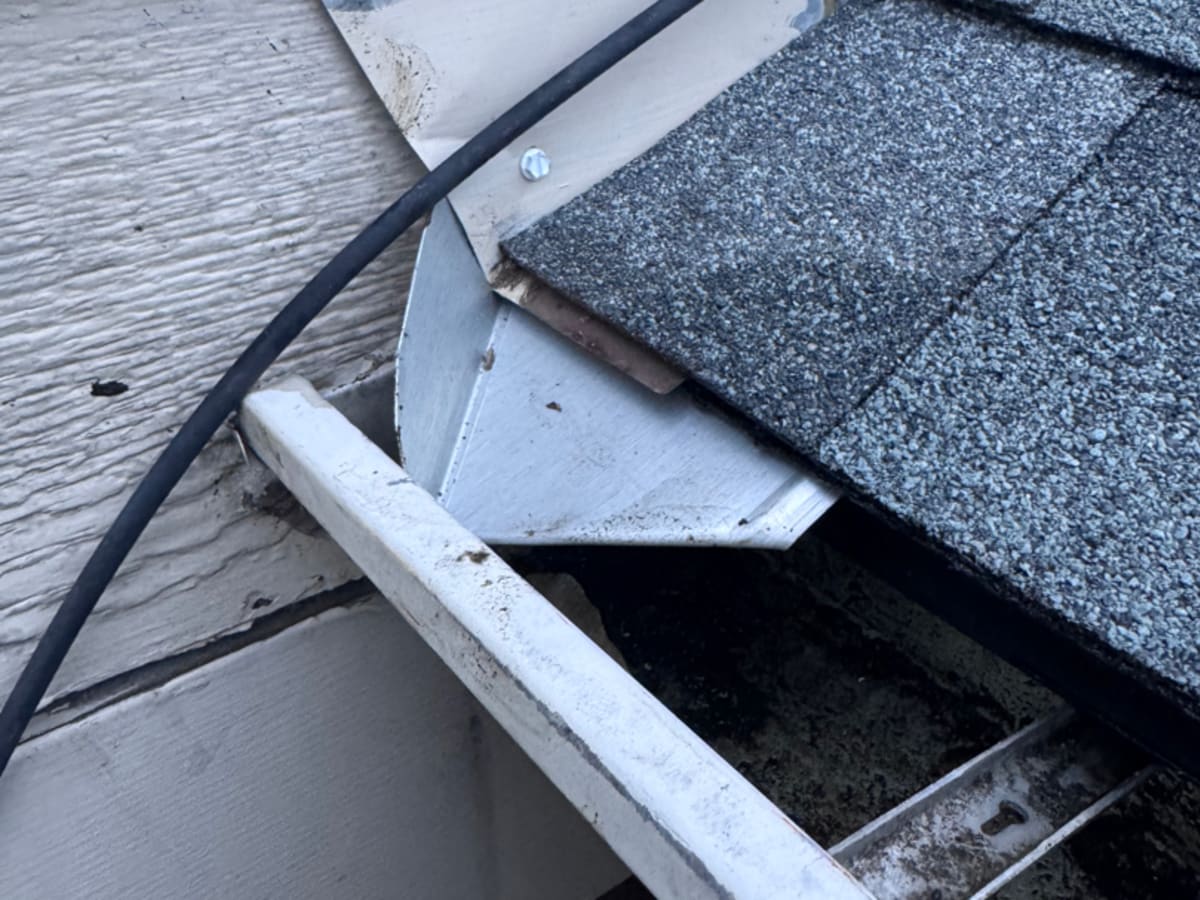
Every gutter seam in America has, at some point, been visited by a man with a tube of silicone and a dream. It works great, too. For about a year and a half. Then one rainy Tuesday the silicone quietly lets go, and the water heads straight for your fascia board.
If you've got a drip coming off a gutter corner, an end cap, or the spot where the downspout connects, this is for you. We'll cover how to tell whether it's really the seam, why seams fail, why silicone is the wrong fix, and what a reseal that actually holds looks like.
First, an honest admission from the gutter business: seamless gutters have seams. The long straight runs are one piece, made on-site from a coil. But every corner is a joint, every end cap is a joint, and every downspout outlet is a hole cut in the bottom of the gutter. (More on that in what "seamless" really means.) Sectional gutters, the kind sold in short lengths at the home store, have a joint every few feet on top of all that. So even a seamless system has seams that can leak.
Step One: Make Sure It's Actually the Seam
A lot of "seam leaks" aren't seam leaks. Water is sneaky. It shows up at the low spot or the corner and lets the seam take the blame. Before anybody buys sealant, rule out these three:
1. It's overflowing, not leaking. Inside corners are where debris piles up and where two roof planes dump water into one spot. If the gutter is packed with leaves or pine needles, water spills over the corner and looks exactly like a corner leak. Clean it first. In Hampton Cove and the wooded parts of Madison, the corner is usually where the pine straw makes its last stand.
2. Water is sitting on the seam. If the gutter isn't sloped toward the downspout, water parks in it. Standing water is hard on sealant. Low-grade caulks soften when water sits on them, and the bond eventually gives up. Fix the slope or the new sealant fails the same way the old one did. Our gutter slope guide covers how much drop a run needs.
3. It's coming from behind the gutter. If the drip is between the gutter and the house, the seam may be fine. Often the roof edge is the problem. A drip edge installed tight to the fascia lets water wrap around it and run down the board behind the gutter. Or the gutter's back edge ended up in front of the drip edge instead of tucked behind it. That's a roof-edge fix (a gutter apron, or rehanging the gutter correctly), not a sealant fix.
The Garden Hose Test
On a dry day, run a hose into the gutter at the high end, away from the downspout. Low flow at first, then turn it up. Watch from the ground with a second person, or from a ladder that's set up right.
- A steady drip under a joint with the gutter not full: that's a seam.
- Water spilling over the front lip at the corner: clog or capacity.
- Water appearing behind the gutter or down the fascia: roof edge or attachment.
- A puddle that stays in the gutter after you shut the hose off: slope.
Mark the leak with a dab of tape on the outside of the gutter so you can find it again once it dries.
Why Gutter Seams Fail in the First Place
Sealant on a gutter seam lives a hard life. Three things go after it.
The metal moves. Aluminum grows when it's hot and shrinks when it's cold, and it does it every single day. Here's the strange-but-true part: metal in direct summer sun can run more than 100°F hotter than the air around it. Take a 40-foot run on a south-facing Huntsville roof. If it goes from about 20°F on a January night to about 150°F on a July afternoon, and you use aluminum's expansion rate of 25 millionths per degree Celsius, that gutter changes length by roughly 7/8 of an inch between winter and summer. All that pushing and pulling lands on the joints at the ends and corners. A sealant that can't stretch eventually cracks or peels.
Water sits on it. We covered that above. A seam at a low spot is a seam with a short life.
It was put on wrong. This is the big one. Sealant fails when it goes on over old sealant, onto a damp or dirty surface, or from the outside of the gutter. That's why a seam can fail twice in a row with a perfectly good product in the tube.
Why Silicone Is the Wrong Fix
Silicone isn't a gutter sealant. It just plays one at the hardware store.
Here's the trouble. Pure silicone won't bond to oxidized aluminum or to the asphalt grit that washes off your shingles, and both are in every gutter older than about a week. It looks sealed. It even feels sealed. Then it lets go all at once.
And here's the part that really hurts. Silicone leaves a film behind. Even when it looks like you've scraped it all off, microscopic residue stays and repels the next sealant you put on. So a silicone repair doesn't just fail. It makes the real repair harder. It also won't hold paint, which matters if your gutters are ever repainted.
The right product is a sealant made for gutter seams. Most pros use a tripolymer sealant, which stays flexible and grips aluminum. Gutter-specific versions, like Geocel 2320, are rated to seal gaps up to 1/4 inch. Bigger than that and you don't have a seam problem. You have a part that has to be refit.
How a Seam Reseal Is Done Right
It's mostly prep. The caulking is the easy part.
1. Wait for dry weather. Not "it stopped raining an hour ago." The inside of a gutter stays damp long after the roof looks dry. Give it a dry day after a dry day.
2. Get all the old sealant out. Scrape it, then wire-brush the joint back to bare metal. "Clean" means bare metal, not "I wiped it with my sleeve." If there's old silicone in there, this step takes three times as long, and that's where it earns its reputation.
3. Clean off the oxide and grit. Weathered aluminum wears a dull gray film. Get it off and let the joint dry completely.
4. Check the fasteners. Corners and end caps are held with rivets. A loose rivet means a joint that flexes, and a flexing joint cracks new sealant fast. Replace loose ones with aluminum rivets. Steel fasteners in aluminum gutters set up corrosion where the two metals touch.
5. Seal from the inside. Run the bead along the joint inside the gutter, where the water is, and cover the rivet heads. A bead smeared on the outside only hides the leak.
6. Leave it alone. Tripolymer skins over quickly, but it's soft underneath for days. Geocel 2300 lists a 4-day cure, and testers found the gutter-specific 2320 needed about 5 days. Check the forecast before you start. A hard rain on day two is not what a soft bead needs.
Done this way, a seam reseal is a legitimately good repair. It's also a ladder job at the roof edge, with your hands full and your attention inside a gutter. If that's not your idea of a Saturday, that's reasonable.
Corner Leaks: The Usual Suspect
If your leak is at a corner, you're in good company. Corners (miters) take the most abuse. Two runs push against each other as they expand. Two roof planes empty into one spot, usually with a valley above it. And it's where debris settles.
A corner that has leaked and been resealed more than once may have a deeper problem. The miter might be cut poorly, the rivets might be working loose, or the corner might be sagging because the hanger next to it gave up. A sagging corner holds water, and water on a seam is how this whole story started. If the corner keeps failing, the fix is usually a new miter, not a fourth tube of sealant.
Check the Wood Behind It
Here's where the jokes stop for a minute.
A seam that has dripped for a while has been dripping on something: the fascia board the gutter hangs on. Water from a leaking seam runs down and soaks into the wood behind it. Tennessee Valley humidity does the rest. By the time you notice the drip, the board behind it may already be soft.
Press the fascia near the leak with your thumb. Solid wood doesn't give. If yours does, or the paint is peeling or the wood is stained dark, the seam is only half the job. Gutter hangers screwed into soft wood pull out, and resealing a seam on a gutter that's pulling off the house doesn't fix much. Our fascia repair cost guide covers what that work involves.
When Resealing Stops Making Sense
One leaking seam on a gutter that's otherwise sound? Reseal it. That's a repair, not a sales opportunity.
But there's a point where you're patching a system that's done. Sectional gutters past twelve to fifteen years old with more than one seam leaking usually fall in that camp. You fix one joint and the next one goes, because they're all the same age and they've all been through the same summers. At that point, a new seamless system with far fewer joints usually costs less over time than chasing leaks every spring. Our seamless gutter cost guide has the numbers so you can compare. Not sure which side of that line you're on? Our repair-or-replace guide has a scorecard for exactly this decision.
We serve Huntsville, Madison, Decatur and the rest of North Alabama. If you'd rather have someone else on the ladder, we'll find the real source of the drip and tell you straight whether it's a reseal or a replacement.
Gutter Seam Leak FAQ
Why is my gutter leaking at the seam?
Most seam leaks come from sealant that has cracked or peeled as the aluminum expands and contracts, water standing on the joint because the gutter isn't sloped to the downspout, or a repair that went on over old sealant or a damp, dirty surface. Loose rivets at corners and end caps also let a joint flex until the sealant fails.
Can I use silicone to seal a gutter seam?
It's not recommended. Silicone doesn't bond well to weathered aluminum or shingle grit, so it tends to peel away. It also leaves a residue that keeps the next sealant from sticking. A tripolymer sealant made for gutter seams is the better choice.
How long does gutter sealant take to cure?
Tripolymer gutter sealants skin over within a couple of hours but take several days to fully cure. Geocel 2300 lists a 4-day cure, and the gutter-specific 2320 has been tested at about 5 days. Seal during a dry stretch with no heavy rain in the forecast.
Why is water dripping between my gutter and the house?
That's usually not a seam. It's typically a roof-edge problem: a drip edge installed tight to the fascia, or a gutter hung in front of the drip edge instead of behind it, lets water run down the fascia behind the gutter. A gutter apron or rehanging the gutter correctly fixes it, and the fascia behind it should be checked for rot.
Do seamless gutters have seams?
Yes. The straight runs are one piece, but corners, end caps and downspout outlets are still joints that need sealant. Seamless gutters have far fewer joints than sectional gutters, which is why they leak less often, but those joints still need to be sealed properly.