
There's a brown ring on the ceiling. It wasn't there last week. It's right over the window in the back bedroom, and every time it rains, it gets a little bigger and a little darker, like it's trying to tell you something.
It is. And yes, clogged gutters can absolutely be the cause. But not every ceiling stain is a gutter problem, and the fix for a gutter leak is very different from the fix for a roof leak. So let's figure out which one you've got before anybody climbs anything.
How a Clogged Gutter Ends Up Inside Your House
Start with how much water we're talking about. An inch of rain on a roof works out to about 0.623 gallons per square foot. That's the standard conversion used by stormwater engineers. So a 2,000-square-foot roof sheds roughly 1,246 gallons in a one-inch rain. That's over 10,000 pounds of water, all headed for the gutters and looking for the exit.
When the gutter is clear, the exit is the downspout. When it's packed with leaves, the water picks its own exit. Usually one of three:
Over the front. The most visible, and honestly the least dangerous for your ceiling. Water sheets over the lip and lands in the flower bed. That's bad for your foundation (a different article), but it usually stays outside.
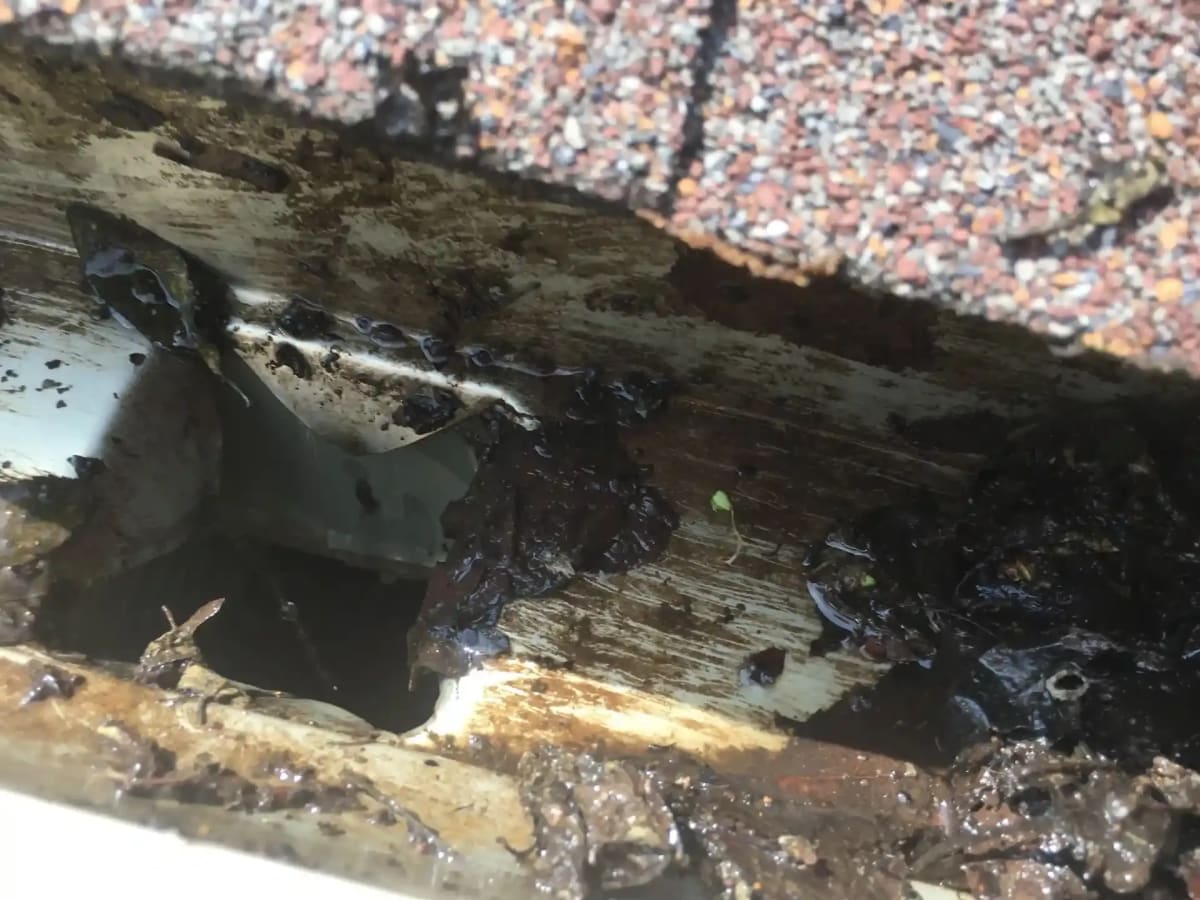
Over the back. This is the one that gets inside. A full gutter can spill over its back edge, between the gutter and the fascia board. From there, water runs down the fascia, soaks into the soffit, and finds the top of the wall framing. It follows the framing down and shows up as a stain where the wall meets the ceiling, usually along an outside wall and often right over a window.
Back up the roof. In a heavy downpour, a gutter that can't drain fills to the brim and holds water at the roof edge, right under the first row of shingles and the drip edge. If there's any weak spot along that edge (old flashing, a gap at the drip edge, rotted roof decking), water gets in at the eave and runs inside.
There's also a Northern way: ice dams. Snow melts on a warm roof, refreezes at the cold gutter, and backs water up under the shingles. Honest admission: that's not a big problem in North Alabama, where snow rarely sits on a roof long enough. When it does happen here, a clogged gutter makes it worse. But if you've got a stain in Madison in May, it's not an ice dam.
Gutter Leak or Roof Leak? Read the Stain
The stain is a pretty good witness if you know what to ask it.
Where is it? Gutter leaks show up at the edges: along an outside wall, at the corner where wall meets ceiling, around the top of a window or door. If the stain is in the middle of a room, well away from any outside wall, it's much more likely the roof. Think flashing around a vent, a chimney, a skylight, or a missing shingle.
Is there a gutter above it? Go outside and stand under the spot. If there's a gutter run directly above that wall, keep going. If the stain is under a part of the roof with no gutter at all, it's not your gutters.
Is it on the first floor under a second story? Watch for this one. On a house with a porch roof or a lower roof section, a leak at that lower roof edge often shows up on the first-floor ceiling or the second-floor wall. The water gets in up high and travels before it shows itself.
When does it get worse? If the stain darkens during or right after a hard rain and dries out between storms, it's tied to runoff: gutters, flashing or the roof edge. If it's there on a dry week, think plumbing, an HVAC line, or attic condensation.
The Hose Test
On a dry day, clean the gutter above the stain (or have it cleaned). Then run a hose into that gutter for 15 or 20 minutes while someone watches the stain from inside. If the stain gets damp when the gutter is full and draining, the gutter or the roof edge behind it is the path. If it stays dry with a clean, flowing gutter, but got worse during storms when the gutter was clogged, the clog was your culprit. Cleaning it may be most of the fix.
Then run the hose on the roof above that area, starting low and working up. If the stain only reacts when water hits the shingles higher up, it's a roof leak, and that's a job for a roofer.
What to Do Right Now
The jokes take a break here. Water in a ceiling can mean water near wiring, and a ceiling that's holding water can come down.
If the stain is bulging or dripping: put a bucket under it and move anything valuable out of the way. A sagging bubble means water is pooling on top of the drywall. If a light fixture is in the wet area, turn that circuit off at the breaker and don't use the fixture until it's dry and checked.
If it's dry between storms: mark the edge of the stain with a pencil and date it. After the next rain, you'll know for sure whether it's growing.
Look at the attic if you can get to it safely, standing on joists, never on the drywall between them. Wet insulation or dark staining on the roof decking near the eave tells you where the water is getting in.
Then fix the source before you fix the ceiling. Painting over a water stain before the leak is stopped is like mopping during the flood. It'll be back.
Fixing It: Usually More Than a Cleaning
If the gutter was the cause, cleaning it stops the new water. But water that's been going over the back of a gutter for a season has usually been soaking the wood behind it. So the full fix often has three parts.
1. Clean the gutter and downspout. All the way through. A downspout clogged at the bottom elbow makes a gutter back up just as surely as leaves in the trough. See our gutter cleaning service if you'd rather not do it yourself.
2. Check the wood. Press on the fascia and soffit near the leak. Soft, stained or peeling wood means the water has been at it a while. That rot has to be cut out and replaced, or the next leak finds its way in even faster. Our fascia repair cost guide covers what that involves.
3. Fix why it went over the back. Sometimes it's the clog alone. Sometimes the gutter was hung too low, or the drip edge is sending water behind it, or the gutter is too small for the roof above it. We cover the roof-edge problem in why gutters leak at the seam. If your gutters overflow even when they're clean, that's a sizing problem, covered in our gutter sizes chart.
Then, once everything's dry and the source is fixed, the ceiling can be repaired.
Keeping It From Happening Again
North Alabama gets two hard debris seasons: fall leaf drop and the pine straw and pollen of spring. Our how often to clean gutters guide covers the timing. If you're under pines in Hampton Cove or along the river in Decatur and the gutters fill up every few weeks, gutter guards are worth a look, especially fine-mesh guards that stop pine needles. And if your gutters are clogging and also heavy, sagging or pulling away, read our post on how blocked gutters become a hazard.
We work across Huntsville, Madison, Decatur, Athens and the rest of North Alabama. If you've got a stain and a clogged gutter above it, we'll clean it, find the path the water took, and check the wood behind it. If it turns out to be the roof, we'll tell you that instead of selling you something that won't fix it.
Clogged Gutters and Ceiling Leaks FAQ
Can clogged gutters cause a ceiling leak?
Yes. A full gutter can overflow over its back edge, between the gutter and the fascia, and run down into the soffit and wall framing. It can also hold water at the roof edge, where it gets in through any weak spot. These leaks usually show up along an outside wall or above a window, not in the middle of a room.
How do I know if a ceiling stain is from the gutters or the roof?
Look at where it is. Stains along an outside wall, at the wall-ceiling corner or over a window, with a gutter directly above, point to the gutters or roof edge. Stains in the middle of a room point to the roof: flashing, vents or shingles. A hose test with someone watching from inside narrows it down.
Will cleaning my gutters stop the leak?
It stops new water from the clog, but it may not be the whole fix. If water has been going over the back of the gutter for a while, the fascia and soffit behind it may be rotted, and the gutter may be hung wrong or undersized. Those need to be checked and repaired too.
Do ice dams cause gutter leaks in Alabama?
Rarely. Ice dams need snow sitting on a roof for days, which doesn't happen often in North Alabama. When it does, clogged gutters make ice dams worse. Most gutter-related ceiling leaks here come from overflow during heavy rain.