
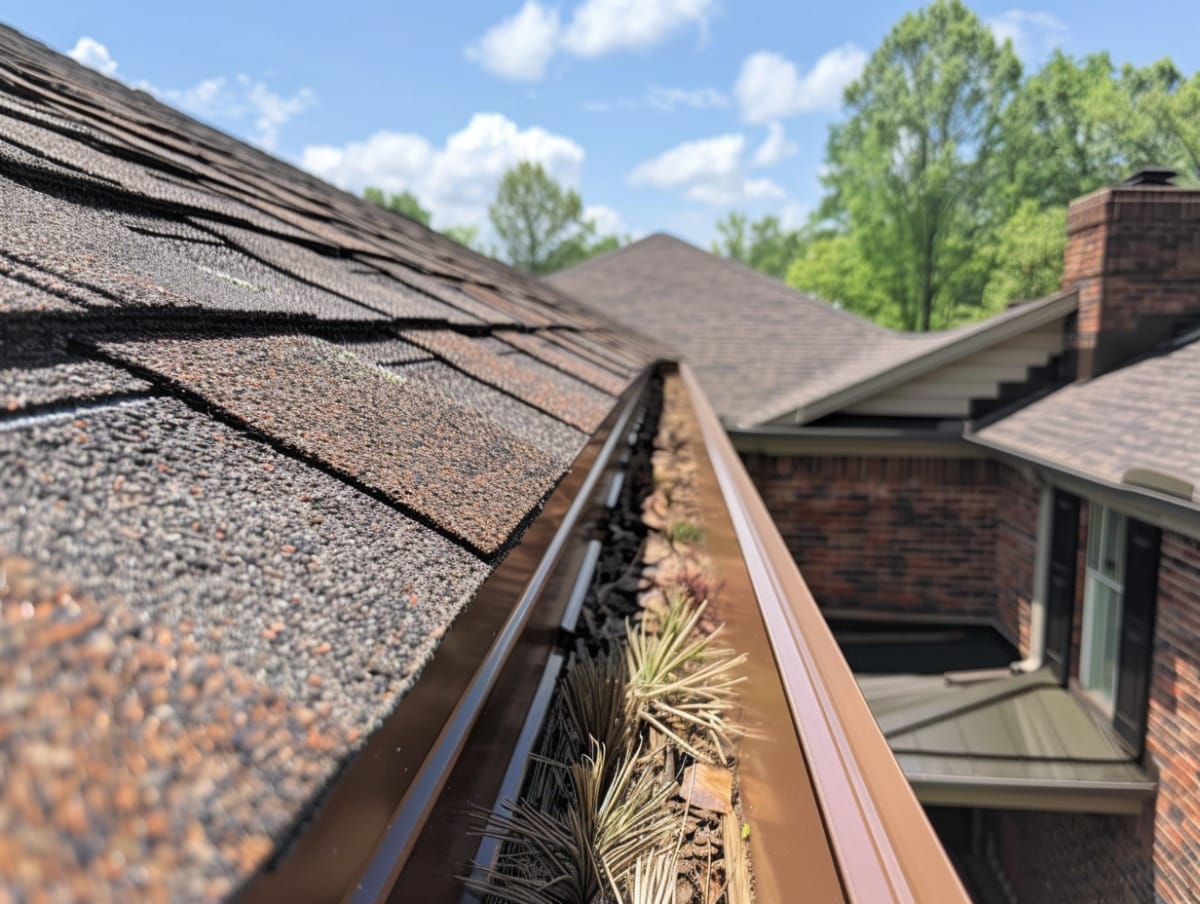
If you've ever cleaned your gutters in October and found them completely clogged again by December, you probably have pine trees in your yard. And if you live in North Alabama, you almost certainly do.
Pine needles are the gutter industry's dirty little secret. Most gutter guards are designed to keep out leaves. They do a decent job with oak leaves, maple leaves, even those helicopter seeds from sweetgums. But pine needles? They slip right through. They wedge into screens. They mat together into an impenetrable layer that water can't penetrate.
Here's what most homeowners don't realize until it's too late: pine needle damage works differently than leaf damage, and it requires a different solution.
Why Pine Needles Are Worse Than Leaves
A red oak leaf falls into your gutter. It's flat, lightweight, and relatively large. Water pushes it toward the downspout. Eventually, it either washes out or decomposes. Your gutter keeps working.
A pine needle falls into your gutter. It's thin, sharp, and designed by millions of years of evolution to stay put. Here's what happens next.
First, that needle doesn't go anywhere. Its shape lets it wedge into gaps, slots, and holes that would easily pass a leaf. It lodges against the bottom of the gutter, against screen openings, against other needles. Water can't push it out because water flows around it, not against it.
Second, more needles fall. They don't pile up loosely like leaves. They interweave. They mat together. Within weeks, you have a dense, woven layer of needles that acts like a sponge on top and a dam underneath.
Third, the mat holds moisture. Unlike leaves that dry out between rains, pine needle mats stay damp. This accelerates decomposition of the needles themselves, creating a layer of organic sludge that's heavier, denser, and stickier than anything leaves produce. This sludge doesn't wash out. It has to be scraped out.
Fourth—and this is the part that surprises people—the decomposing needles are acidic. Pine needles have a pH around 3.2 to 3.8. That's more acidic than orange juice. Over time, this acidity can corrode aluminum gutters from the inside, creating pinholes and weak spots that lead to leaks.
North Alabama's Pine Problem
Alabama is pine country. The longleaf pine is our state tree, and for good reason—before logging changed the landscape, longleaf pines dominated millions of acres across the state. Today, you'll find three main pine species creating problems for homeowners across the Tennessee Valley.
Loblolly Pine (Pinus taeda) is the most common pine in Alabama. These fast-growing trees reach 100 feet tall and drop needles year-round, with the heaviest shedding in fall and early winter. Loblolly needles are 5-9 inches long and come in bundles of three, making them particularly good at tangling together in gutters.
Shortleaf Pine (Pinus echinata) grows throughout northern Alabama, especially in the foothills and ridges of Madison, Morgan, and Limestone counties. While its needles are shorter (3-5 inches), they shed in massive quantities. A single mature shortleaf can drop thousands of needles per day during peak season.
Virginia Pine (Pinus virginiana) is common in the drier, rockier areas of North Alabama. You'll find these scrubby pines on slopes throughout Hampton Cove, Monte Sano, and the areas around Guntersville Lake. Their short, twisted needles are smaller than other species but shed heavily and mat together quickly.
The problem isn't that any one tree drops too many needles. The problem is that most North Alabama properties have multiple pines—often a mix of species—dropping needles on overlapping schedules throughout the year.
Where Pine Needle Problems Hit Hardest
We see the worst pine needle gutter damage in specific areas across our service region. If you live in one of these locations, pay close attention.
Monte Sano and Surrounding Areas: The mountain communities east of Huntsville are heavily forested with Virginia and shortleaf pines. Homes on smaller lots often have pines literally overhanging the roofline. These properties need gutter cleaning every 4-6 weeks during fall—or proper protection.
South Madison and Hampton Cove: The newer developments in these areas were carved out of pine forests. Builders left trees for aesthetics, but those trees are now 20-30 years old and dropping serious volumes of needles. We've seen homes in Hampton Cove subdivisions with gutters completely packed within 60 days of cleaning.
Rural Morgan County: Properties around Lacey's Spring, Somerville, and Priceville often sit on larger lots surrounded by loblolly plantations or natural pine stands. The sheer volume of needles these properties receive can overwhelm even aggressive cleaning schedules.
Lake Guntersville Area: The shores and ridges around Guntersville Lake support dense pine growth. Homes in Arab, Guntersville, and Scottsboro deal with both direct needle drop and needles blown in from surrounding forests.
Decatur's Older Neighborhoods: Mature pines planted 40-50 years ago in established neighborhoods are now massive trees dropping proportionally massive amounts of debris. Properties near Point Mallard and along the river have particularly heavy pine coverage.
Why Standard Gutter Guards Fail
Walk into any big-box home improvement store and you'll find a wall of gutter protection products. Most of them work reasonably well for leaves. Almost none of them work for pine needles. Here's why.
Screen Guards: Traditional aluminum or plastic screens have openings sized to block leaves—typically 1/8 to 1/4 inch. Pine needles are roughly 1/16 inch in diameter. They slide right through. Some get caught halfway, creating perfect anchor points for the next needle, and the next, until you have a mat of needles sitting on top of a screen that water now can't penetrate.
Foam Inserts: These polyurethane or polyether foam blocks sit inside the gutter and theoretically let water flow through while blocking debris. Pine needles love foam. They embed themselves in the foam's surface, creating a dense layer that neither sheds nor allows water through. Within a season, the foam is essentially a needle-covered sponge holding water against your fascia.
Brush Guards: These look like giant bottle brushes that sit in your gutter. Leaves blow off or decompose around the bristles. Pine needles? They embed in the bristles and stay there forever. We've removed brush guards that weighed three times their original weight due to accumulated pine needles.
Reverse Curve Systems: These hoods use surface tension to direct water into the gutter while debris falls off. They work well for leaves. Pine needles, however, are small and light enough to follow the water around the curve. Once inside, they accumulate just like in an unprotected gutter—except now there's a hood on top making them harder to remove.
The fundamental problem is that most gutter guards were designed for broad-leaf trees common in the Northeast and Midwest. North Alabama's pine-dominated landscape creates debris patterns these products weren't engineered to handle.
What Actually Works: Micro-Mesh Protection
The only gutter guard technology that reliably stops pine needles is micro-mesh. Not regular mesh. Not perforated aluminum. Micro-mesh—specifically, stainless steel micro-mesh with openings small enough to block even the finest debris.
Micro-mesh gutter guards use a fine stainless steel screen with openings typically measured in fractions of a millimeter. For comparison, a standard window screen has openings of about 1.5mm. Quality micro-mesh guards have openings of 0.2mm or smaller—small enough to block pine needles, shingle grit, seeds, and even pollen.
The key isn't just the mesh size. It's the mesh material and frame design.
Stainless steel mesh maintains its shape under the weight of debris, the pressure of water, and the expansion and contraction of temperature changes. Aluminum mesh and plastic mesh deform over time, creating pockets where debris accumulates. Stainless steel doesn't.
Proper frame pitch determines whether debris sheds or sits. Micro-mesh guards should install with a slight forward pitch so debris slides off the front edge rather than accumulating on top. Flat-installed guards—regardless of mesh quality—will eventually hold a layer of debris that blocks water flow.
Frame attachment matters for longevity. Guards that clip to the gutter lip without secure fastening can lift in high winds, letting debris underneath. Guards that require lifting shingles can void roof warranties. The best systems attach securely to the front of the gutter and slide under the shingle edge without disturbing it.
Gutter Guards We Install and Recommend
At Blue River Gutters, we install several micro-mesh systems depending on the specific needs of your property. Our primary recommendations are products like Gutter Rx, which offers professional-grade protection at a reasonable cost compared to heavily-marketed national brands.
Here's how to evaluate any micro-mesh system for pine needle protection:
Mesh material: Should be stainless steel, not aluminum or plastic. Stainless maintains filtration quality over time.
Mesh opening size: Should be small enough to block shingle grit (roughly 0.5mm or smaller). If it blocks shingle grit, it blocks pine needles.
Frame material: Aluminum frames provide the best combination of strength, corrosion resistance, and workability.
Installation method: Should attach securely without penetrating the roof deck or requiring shingle removal.
Water handling capacity: Should be rated to handle rainfall intensities common in our area—at minimum 4 inches per hour, preferably higher.
We evaluate your specific situation—tree coverage, roof pitch, gutter size, and debris types—before recommending a system. What works for a home with two pine trees is different from what works for a home surrounded by forest.
Cleaning Frequency: With and Without Protection
How often do gutters actually need cleaning in pine-heavy areas? Here's what we see across our service area:
Without gutter guards, properties with significant pine coverage need cleaning every 4-8 weeks during fall and early winter (September through January), plus at least quarterly the rest of the year. That's 8-12 cleanings per year minimum. Heavy pine coverage can require monthly cleaning year-round.
With standard gutter guards (screens, foam, brush), cleaning frequency drops initially but often returns to unprotected levels within 2-3 years as the guards themselves become clogged or damaged. Some guards actually increase cleaning difficulty because needles trapped under or in the guard are harder to remove.
With properly installed micro-mesh guards, most pine-heavy properties can reduce cleaning to an annual inspection and light maintenance. Some debris may accumulate on top of the mesh during heavy needle season, but it sheds naturally with rain and wind. The gutters themselves stay clear.
Here's the math: Professional gutter cleaning runs $150-250 per service for most single-story homes in our area and $200-350 for two-story homes, depending on size and access difficulty. At 10 cleanings per year, that's $1,500-3,500 annually. Quality micro-mesh guards typically run $7-15 per linear foot installed. For a typical home with 150-200 feet of gutter, that's $1,050-3,000 installed.
At that cleaning pace, guards can pay for themselves within about two years through reduced cleaning costs alone—not counting the foundation damage, fascia rot, and landscape erosion that clogged gutters cause.
Signs of Pine Needle Damage to Watch For
Pine needle accumulation causes specific types of damage that differ from standard leaf clogging. Watch for these warning signs:
Black or brown staining on fascia boards: Decomposing pine needles release tannins that stain wood. If your fascia has dark streaks running down from the gutter line, needles are likely sitting in standing water against the fascia.
Moss or lichen growth on the roof edge: The constant moisture from clogged gutters creates ideal conditions for moss and lichen. If you see green or gray growth along your roofline, your gutters aren't draining properly.
Pinholes in aluminum gutters: The acidity of decomposing pine needles can corrode aluminum over time. Tiny holes that appear along the bottom of the gutter—often first noticed as drips during rain—suggest long-term pine needle accumulation.
Sagging gutter sections: Pine needle accumulation is denser and heavier than leaf accumulation. Gutters that hold water and decomposing needles can weigh two to three times their intended load. Look for sections that bow or pull away from the fascia.
Landscaping erosion near the foundation: If one section of your landscaping is consistently eroded while others are fine, you likely have gutter overflow at that location. During heavy rain, check for water pouring over the gutter lip rather than flowing to the downspout.
Basement or crawlspace moisture: Clogged gutters dump thousands of gallons of water directly against your foundation. If you notice musty smells, humidity spikes, or actual water intrusion below grade, gutter failure is a common culprit.
The Best Time to Install Gutter Protection
There's never a bad time to protect your gutters, but timing affects both installation ease and immediate benefit.
Late winter/early spring (February-April) is often ideal. Needle drop has slowed, making it easy to thoroughly clean gutters before installation. You're protected before the heavy spring rains that stress drainage systems. And you avoid the fall rush when everyone suddenly remembers their gutters need attention.
Summer installation works well logistically—longer days, predictable weather, and fewer scheduling conflicts. The downside is that you'll pay for cleaning before installation, only to face immediate heavy debris once needle drop resumes in fall.
Fall is when most people think about gutter protection, precisely because they're dealing with the consequences of unprotected gutters. Installation is absolutely possible and beneficial, but expect scheduling delays as demand peaks. Installing mid-season means some debris will already be under the guards, requiring cleaning first.
The honest answer is: install protection whenever you're ready to stop dealing with the problem. Every season of unprotected gutters during heavy pine needle drop is another season of potential damage to your fascia, foundation, and landscaping.
Taking Action
If you're reading this article, you probably already know you have a pine needle problem. Maybe you've been cleaning gutters yourself every few weeks. Maybe you've paid for professional cleaning multiple times a year. Maybe you've already tried gutter guards that didn't work.
Here's what we recommend:
First, honestly assess your pine coverage. Count the mature pines within falling distance of your roof. Look at your neighbors' trees too—needles blow. If you have more than two or three significant pines affecting your roofline, standard solutions won't cut it.
Second, evaluate your current gutter condition. Check for the damage signs we described above. If you already have sagging sections, corroded areas, or damaged fascia, those need to be addressed before or during guard installation.
Third, understand that not all micro-mesh guards are equal, and installation quality matters as much as product quality. Proper pitch, secure attachment, and correct sizing all affect long-term performance.
We've been solving gutter problems across North Alabama for over 20 years. We understand local tree coverage, debris patterns, and what actually works in our environment. We'll evaluate your specific situation, explain your options, and give you honest recommendations—whether that's micro-mesh guards, different downspout configurations, or in some cases, simply more frequent professional cleaning.
Pine needles aren't going to stop falling. Your gutters need protection that actually works.